*heavy spoilers*
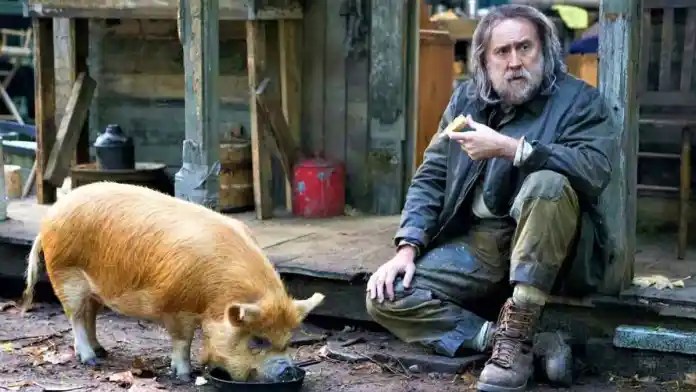
Nic Cage’s skills are so polished in the here and how, juxtaposing Pig and Mandy is a treat for anyone who is a fan. It is interesting as a dichotomy because Pig has such a somber, sullen tone to it and there are such wonderful soft hues of the earth, golden and relaxing to take in. Deep browns, muted tans, receding into the background. In both films, I love the lack of dialogue because what makes them both so wonderful is that Pig is my favorite of the year.
There has not been a story told exactly like this. Technically John Wick and his dog can be connected to Rob and his pig. However, Rob unfolds as he adapts to each change as we are learning about him. Alex Wolff is absolutely fantastic. I always wanted to know more about who his character is, but I was pleased with what I learned in the brief windows into his identity that the film gave us. It really engaged me and had my heart wrapped up in it, no matter what confusion came about, I stayed patiently waiting to find out what it meant and why it was there.
Pig, while the description is more concise, it is because you need to see it and interpret on your own, otherwise this work of art will be tarnished by too much talk. Conversations and score within it are so mild in comparison. Nic is also so very different in both narratives. While he emotes similarly in anguish and in grief, he is so much louder in his frustration and grief in Mandy, because he acts on it toward the people who cause his pain. In Pig, Rob’s inability to direct his overwhelming feeling of loss ends up being a springboard for him to get up and change his life.
There is a quite meditation on life in Pig. Rob is silently struggling and isolated from the world, but he draws the viewer in by the simplicity of his daily life. Once you discover his incredible and unsurpassed talent as a chef that he puts his heart and soul into through his delicately artful cooking, you begin to understand why he has taken a giant step away from it all. Slowly and unyieldingly, he presses forward to find his truffle mushroom seeking pig that was stolen while he was violently attacked and knocked unconscious. His deep-seated pain is not directed towards the assailants, but in a way, toward how life has cheated him and brought him to where he is now. This innocent creature is an extended metaphor and symbol for another loved one that was taken from him.
His faithful little companion had taken on a replacement role, without it, he had to turn everything around to get back to the world, resurrect, rejoin society, despite feeling like he was dying on the inside. He needs someone to share compassion with, seeing his pig as someone to care for and show affection toward, the subsequent bereavement makes him step up and leave his way of being. This isn’t a movie to pull apart piece by piece, it is meant to be enjoyed like the 5-star dishes Rob creates. There are only a few brief moments when he cathartically releases his sorrow, but if you view this movie the way it is intended, that is all you need.
Pig is captivating, taking a moment, entranced, like walking through a gallery, viewing a work of art that steals the show, all my focus zeros in on it and I am in the world of what is in front of me. It is an apogee, a pinnacle, a paradigm of greatness in art. Much like Picasso’s “Woman Ironing”, this film locked me in and everything else around me disappeared, mystifyingly transporting me into its creation. It is so distinctly delivered compared to Mandy and it is a brilliant way to accentuate its greatness and subtlety especially from the notorious man, myth and legend that is Nicolas Cage.
In Mandy, the characters’ chaotic shift from their happy routine is the spark that sets each one alight onto a path of growth. Each pairing, in both movies, has a quiet setting together secluded from the cacophony of cityscapes and turbulent tumult. Side by side, this was interesting to see how each persona deals with mourning and the importance of love. Brainwashing via a potent mind-altering drug is a system of control in Mandy. The giant bug breaking his skin to infect the mind is also a tool. Odd pairing but great together for all these reasons.
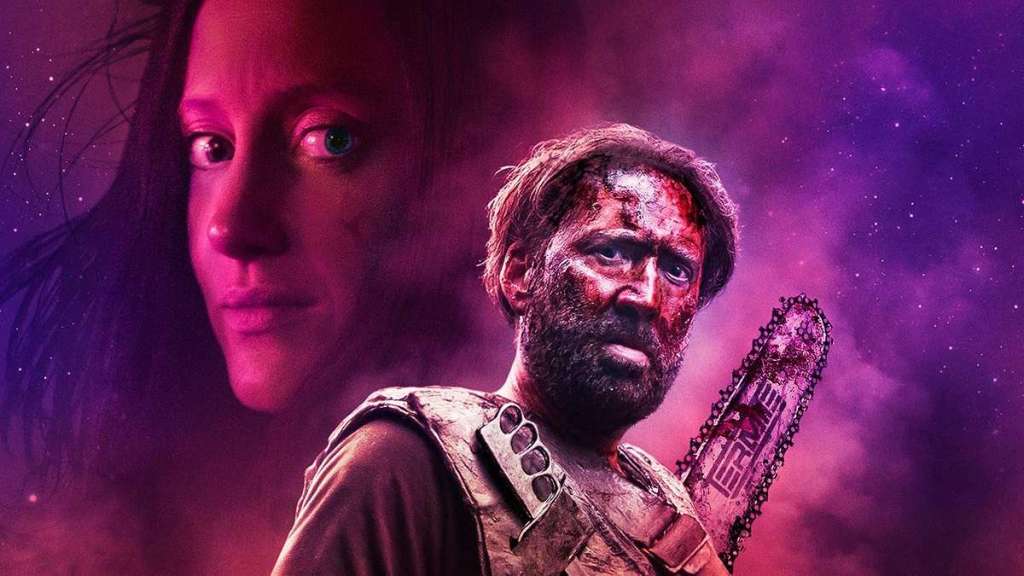
Mandy, as I will describe has a starkly contrasted difference in colors, almost fluorescent, blue, purple, deeper neon, magenta and so on was used perfectly. This film is quite loud visually and in its literal volume of various sounds. The cinematography is dripping with masterful composition. All of which causes you to search the entire setting to see everything that may or may not be important. Andrea Riseborough was reticent and reserved as the titular character, aiding in the genuine and believable romance between her and Red. As a choice in color, he is constantly depicted as his name throughout the course of the entire film.
There are allusions to: Hellraiser, a freakshow band of weirdos, seemingly supernatural, 13 Ghosts, violent creatures, a bit of Antichrist, an unbreakable bond despite their dystopian surroundings. Additionally, Texas Chainsaw Massacre is akin to the way Mandy wakes up to the reclusive family of psychos. Jeremiah as the leader is reminiscent of the eerie tension within the members of the village in Midsommar as well.
Mandy’s reflective description of the innocent birds placed into a sack only to be beaten to death, foreshadows what will happen to her and others in the story. Her reading that novel, is also a hint toward future events, the cover art of the book being symbolically derivative of the closing credits. So much of the theme is based on the endless expanse of the universe. Their life starts peacefully and is quickly upended by a group of overzealous zealots in a strange gothic gang. Not every element is explained, but it is awesome.
Mandy and Red open this movie, describing their favorite planets. She describes a figurative rage within herself, akin to the planet that has exhibited the same storm for 1000 years. None of this feels expository. We are given the visualization of the fire between them while the flames softly glow on her face fading in and out. The viewer is constantly reminded of their spiritual and metaphysical bond. Her drawings tell you who she is as well, as you watch her getting immersed in the artwork, observing the girl surrounded by the beautiful colors. “Show don’t tell” and this movie gets it.
Next, there is a shot where they transition from her reading the book to her and the mysterious glowing rock that she walks through. The silhouette of her body appears like an outline of a lion or something other, ultimately becoming the negative space of her path between the mountains. She is stopped by the headlights of the cult members who will attack her. Everything looks amazing, the car darting through the narrow split, the gorgeous vanishing point is a stunning sight to see.
Shortly thereafter, she is confronted by Mother Marlene. This interaction seems like a nod to Fuseli’s “The Nightmare” in composition, while her haunting voice could be that of the looming gargoyle.
Color tones highlight the prominence of where they are what they stand for. Red helplessly looks on as he sees the smoldering ashes of Mandy, he is silenced by shock and trauma. All the colors tell the story. Outer edges of her are bathed in blue, glowing, barely emitting light, with a soft orange, a tinge of fire in the red, all metaphorically representing a shred of her spirit still living on. The camera centers on Red’s blood-soaked face after the beatdown from his captors, amidst the contrast of his bright blue eyes. He goes inside and picks up the shirt that connects him to her, holding onto what he has left of her.
On the television, the PSA chanting “This is only a test” coupled with the jarring buzzing sound communicates a sense of urgency that the cult was testing him. There is a wonderful transition into the animated decay of the female figure, a possible version of Mandy, which maybe what he sees in his dreams/visions to illustrate how he feels. Concretizing the weight of grief culminates in a great gut-wrenching scene inside the bathroom, where he shows how he feels in the wake of her death. Drinking profusely demonstrates how there isn’t enough alcohol in the world to numb his pain.
Red’s officially received “the call” on the hero’s journey, THE call to action. Naturally his mentor in the van leads him, and Caruthers (Bill Duke) is fantastically stoic and strong while Red is breaking apart at the seams. He takes a literal nosedive into cocaine on a shard of glass, coupled with some substance like LSD, putting him past the turning point, when he is not going back and will finish this. The protagonist is constantly battling internal, external and existential conflict which brings every plot element together.
As he is gilding and soldering the double-edged warhammer weapon, (perhaps a combo of a scythe and an ax), pouring the metal in, there is a wonderful mix of blue and red tones. Another comparison between ice and fire occurs, especially in glow of it on his cheeks, lighting the torch to solidify it. There is a gigantic aura of red on and around him while he is driving against the blue sky, and it explains and shows how he feels with color and placement.
One of the best parts is the leather-clad lunatic describing Mandy’s burning body. Soon after, he swiftly decapitates him and proceeds to light a cigarette off his burning head. It is important to note that the faces of each “Black Skull”, are relatively faceless to create the allusion that evil and death may be unrecognizable and undiscernible. They are elements of existence that are not so definitive, being an abstract concept that we all know but do not fully understand.
Coldly cutting to the skeletal chemist in the lab, his monologue is ethereal and devoid of warmth setting the tone for the whole scene. There is a little touch of red on the recorder playing the music that overlays everything as if it were the score. Delving into a dark pact, knowing that death sometimes pays for life can change whether loss will beget more loss. Will taking other lives replace of fill the gaping wound of Mandy’s absence? This character’s voice carries in waves of vibrating sound that is chilling especially coming from his sunken cheeks, a bony face covered by a paper-thin layer of skin.
Within the next vision, he sees a Mandy-like figure over the corpse of a half-human, half-tiger body, pulling out the heart, glowing green, holding it up. Her hair curls and curves as snakes, like Medusa, then it pans to the edge of this tiny narrow space between the mountain tops that goes on for eternity. Countless moments show character, setting, and mood masterfully.
Then the triptych of the triangular roofed chapel is externally and internally fantastic in its tunnel-like depth. Once inside, Red climbs down into the depths of eternal damnation to rescue Mandy’s soul through revenge. Until he finds the ultimate embodiment of evil, the orchestrator of the crazy fanatic organization. While he is in the catacombs of the chapel, he is shown in silhouette with flames curling up behind him exemplifying the peak of his fury. During their battle, he has a demonic voice go through him, momentarily possessed or possibly overwhelmed by the hallucinogenic drugs. Jeremiah pleads, going through all the stages of death in rapid succession, grieving with strange moments of ecstasy in between.
While this story is rollercoaster of feelings, it ends with a beautiful blanket of serenity going back to Red’s memory of meeting Mandy for the first time. Very quickly and madly falling in love with her, starting in blue, in stillness and softness. When he sees her, the red flows over between them. We then see how she is with him in the car as he drives away from it all. He can finally let her go, avenging her death and setting her free. Mandy was a wild ride, sad and tragic, but a picturesque journey of being thrown into chaos and emerging as hero.
It all closes with a scene of the hovering planets in the backdrop, possibly multiple moons, leaning to what it means to exist, connecting to others and yourself. Ironically, the director’s name is Panos Cosmatos, which to me, alludes to traveling throughout the cosmos.
As a wonderful afterthought, the post credits include a series of sketches of him, seemingly done by Mandy. Perhaps there is an alternate timeline or place of existence where she is watching him do what he does.
Pig is subdued, Mandy is cacophonous, but observing them together and watching each film back-to-back, they shine so beautifully in their own ways.
 Through the Looking Glass